The writer’s i’m resonating with the most lately all consistently hold a longer view of time.
Richard Rohr describes deep time in lots of his writing eg Falling Upward.
In The Art of Possibility, Ben Zander encourages his orchestra us to appreciate the long lines of the musical piece they’re performing, as opposed to focusing on one particular bar or section.
Seth Godin commends Gary Vaynerchuk for consistently adopting a longer view posture of time, such that “At anytime, the short-term thinker thinks you’re an idiot!”
In Simon Sinek’s most recent book, The Infinite Game, he critiques short-term institutional metrics such as published quarterly results in business, which push people to focus their performance on the immediate. The owners of these companies, individual or institutional shareholders, often have no long term commitment to them, and can sell at any time at the click of a button. Our politics are no different with relatively finite terms of office.
Then of course there’s that great author, Jesus, who the New Testament writer’s described as the Word. He told his followers to pray “Your Kingdom come, your will be done on earth as in heaven.” and went onto describe this Kingdom like a seed, or yeast… small beginnings seem inconsequential to him in the context of the long lines of time.
As we seek to add value to the people around us, are we making short-term reactionary deposits, or long-term purposeful investments?
So what forward movement can come from all of these reflections on value?
Once we’re aware of the value we can create (including our unique value add)…
And we’re committed to adopting an empathic posture as we anticipate the value others seek…
We can make more focused and intentional choices about the way we deploy our time, energy and resources.
We can establish boundaries around both the value we can and/or are willing to add….
And the value we either can’t or choose not to add.
We consciously lean into the former and purposefully withdraw from the latter.
This leads to meaningful and effective partnerships, and also significantly reduces the friction that comes from a set misaligned values.
The list of implications flowing out of all of this for us at Forever Projects is long, and includes:
1. Being clear on the value we add as a charity. From a fundraising point of view, when someone donates $50, what was valuable from their perspective? What story or emotion? What about $500, or even $50,000?
2. Ensuring our written/spoken/published values actually match (1)
3. An ongoing process of tuning and retuning our radar to the kind value we believe our donors, partners, potential staff and volunteers are seeking.
4. Sticking to our boundaries, trusting that over time, we’ll make increasingly accurate choices around where, when and for whom we attempt to add value, such that our overall impact is maximised. Because every time you say yes to something, you’re saying no to something else.
What are you saying no to so, that you can say a yes to adding your unique value into the world?
Once we’re more closely tuned into the unique value we have to offer, and, starting with empathy, we’re clearer on what other people find valuable, we can participate in an endless game of generously offering our value, noticing how it’s received, reflecting, iterating and repeating.
That’s it.
A few reflections about this movement towards adding unique value…
1. Seasons – inevitably, periods of time will come and go when, for whatever reason, we can’t add what we believe is our unique value. If we can adopt a longer and deeper view of time, then we’ll be open to the possibilities that present themselves during these seasons, as opposed to being blinded by a longing for somewhere or sometime else.
2. Shipping – the fastest way to actually learn how valuable your value is involves putting it out there into the world. Sharing your ideas and value in a way that another human interacts with it. Their response will determine how much value you provided. Perhaps it would have been more valued by someone else? Or maybe you need to tweak your value offering. You’ll never know until you get actual feedback. As Seth Godin says when riffing on shipping…. don’t save as draft, ship!
3. Self-awareness – how much of your own ego and identity is tied up in this? How much uniqueness is actually unique to this value you’re adding, and how much of it is a convenient story you tell yourself? Are you really irreplaceable? The only one that can do xxxxx? Or is there another storyline beneath the surface you’re wilfully ignoring?
There’s the value we think we’re adding to another person or organisation. But that may not actually be what they wanted.
Our value might not be as valuable as we think it is!
Empathy helps us see the world through another’s eyes. By trying to stand in their shoes, we have the potential to move closer to appreciating what they see, feel, think, and value.
This year I have all of Wednesday off from my job at school. From term 2 onwards, i’ll use that, with some other half-days throughout the week, as another opportunity to work on growing Forever Projects. But in term 1, i’m enjoying a day with my youngest son Max, who’s just started Kindergarten and gets Wednesdays off during the first term.
We’re calling them Daddy Maxy days.
Yesterday was the first one. I’ve had all of these ideas about what we could do together… climb Mt Kembla, go to Port Kembla beach for the day, get a train to Stanwell Park and watch the hang gliders off the coast, enjoy a nice coffee and hot chocolate at a cafe in town, finally teach him to ride a bike without training wheels…. the options in my mind are endless!
But when I asked him what he wanted to do…
“Let’s stay home!”
His top 3 ideas were (1) me to read him a Star Wars book, (2) jump on the trampoline together in his pyjamas and play his favourite game ’round and round’, and (3) play limbo with a random piece of string that’s tied to a door inside our house.
Talk about squandering an opportunity!
But is this about me, or him?
I’m not saying we should let our 5 year olds decide what we do all day. But I am saying I shouldn’t kid myself when the options are perhaps more about my ideas and future memories than his.
So we kicked off the day with his list, and he loved it.
Then we went into town and rode his bike, and he was thrilled with how quickly he learned to ride without the training wheels!
But we started with him.
This principle of empathy has implications for every aspect of our lives and the value we’re adding.
What value do you think you’re adding, and how could you find out if it’s actually valuable?
So there’s the value that we can add to people and our world.
Our contribution.
What we have to offer.
Then there’s the value that others want.
What they – as individuals or organisations – are seeking out and have decided is valuable to them.
Economically, it comes down to value supplied (by us) and value demanded (by others). There’s a whole tangent here related to putting a price on this value we offer, but that’s a separate rabbit hole.
I often think in nerdy maths diagrams about all of this stuff, and in this case… it’s the good old Venn diagram!
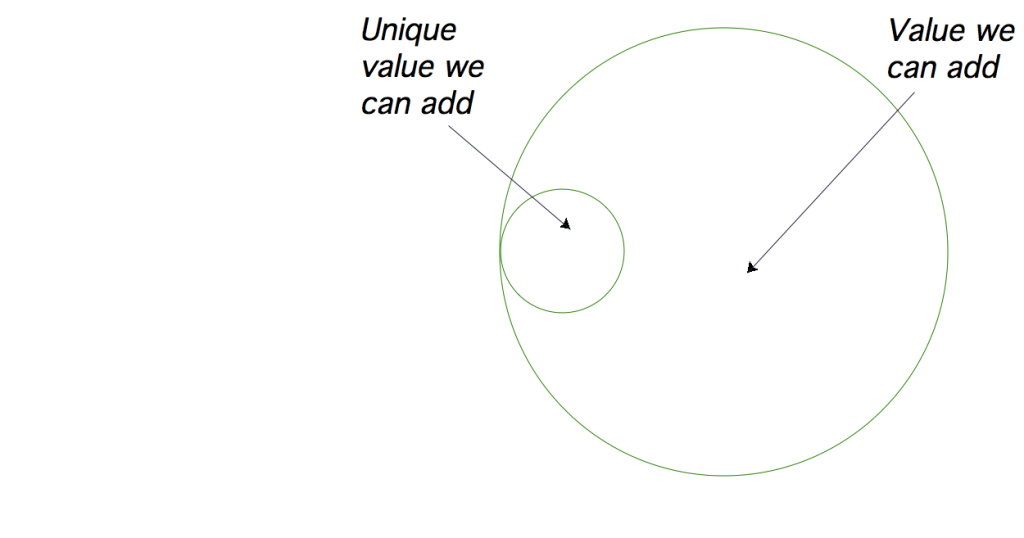
Diagram 1: The unique value we have to offer is a subset of the total value we have to offer
This first diagram flows from yesterday’s post about unique value add. Most of us have the potential to work in hundreds or thousands of jobs. But there are very few if any we could say we’re in a unique position to do.
Same goes for relationships, friendships and connections… of all the people we have the potential to spend time with, how many would say we play a unique, almost irreplaceable, role in their lives?
This brings us to partnerships, which can range from non-existent, to weak, to mediocre, to strong, all the way to flourishing.
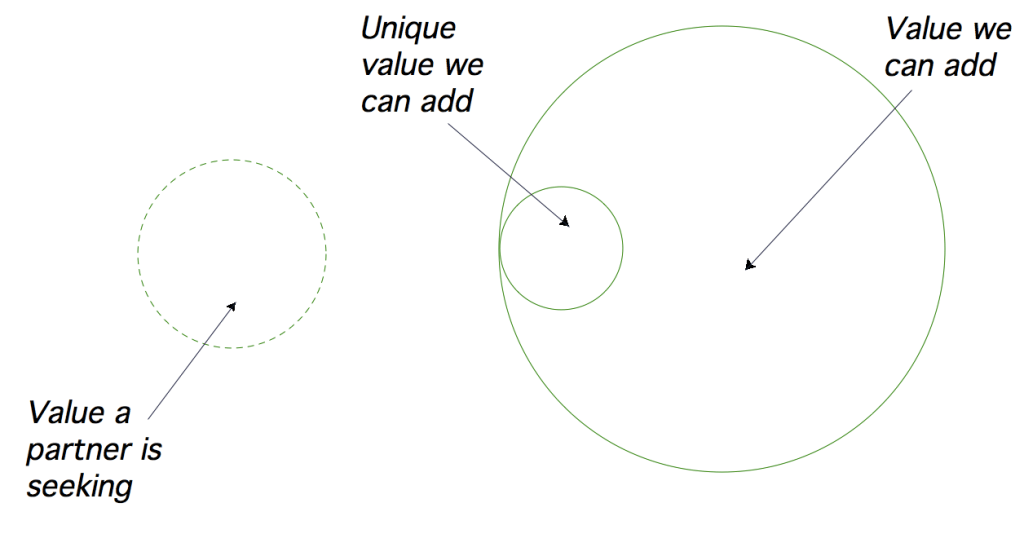
Let’s assign a new dotted circle to the value this partner (again, it could either be an individual or an organisation) is seeking out. Obviously there are seemingly infinite partners out there of varied sizes, but for now we’ll keep it simple and consider just one.
Diagram 2: A potential partner enters the scene on the hunt for some value
In the above situation, there is zero value exchange because there is no intersection between the value they seek and the value we offer.
A company we aren’t qualified to work for. Someone we can’t connect with for whatever reason. A store we don’t want to buy from.
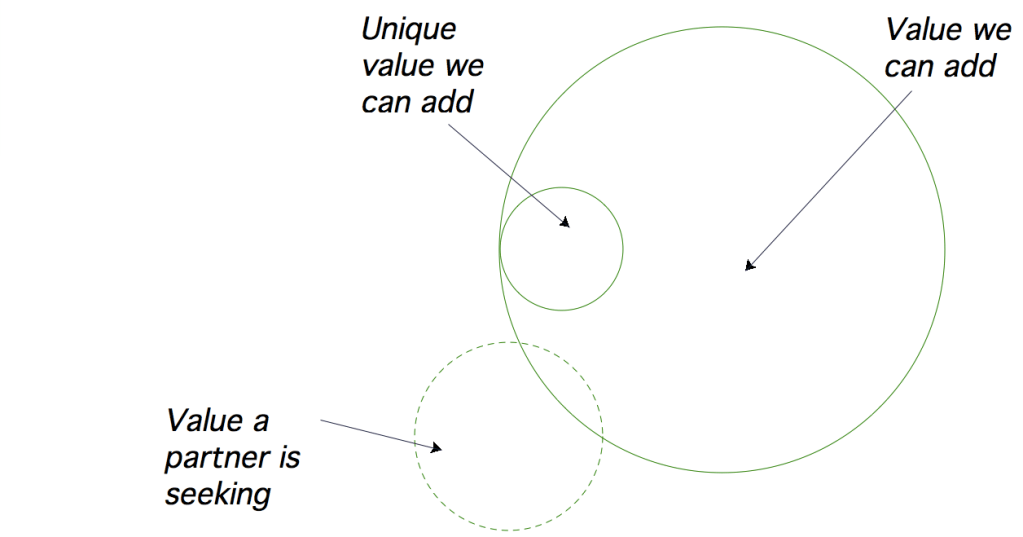
However, once there is at least some intersection and the circles begin to overlap, a partnership is established.
Diagram 3: The value exchange begins
When their circle starts to significantly overlap with ours, we’re making a significant contribution to their journey, and our partner really values us.
Diagram 4: Filling our partners value tank
But how does this leave us feeling about our contribution?
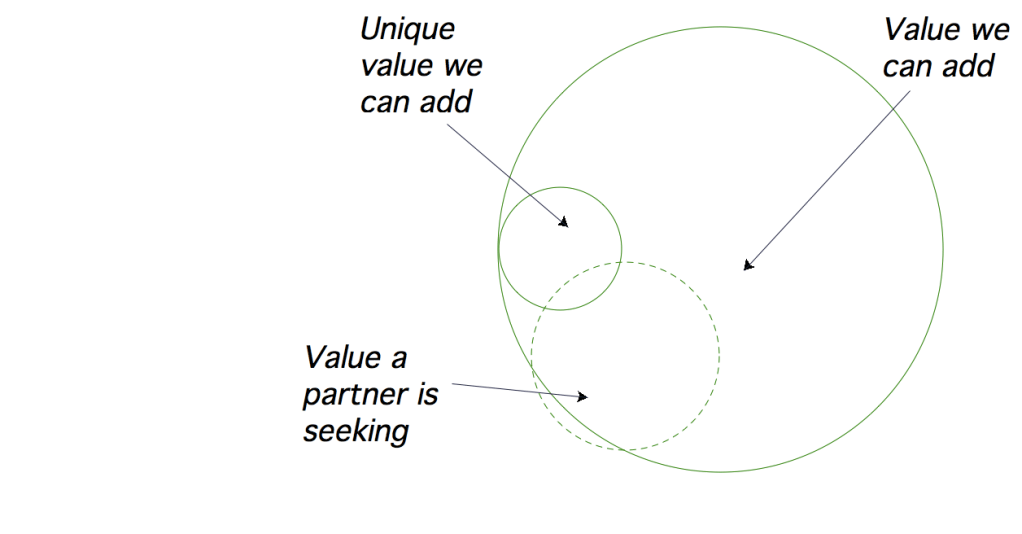
With limited time, energy and attention, and a zillion other circles floating around demanding our time, energy and attention, would the strongest partnerships for our world exist when we begin to provide what we believe is our unique value?
Diagram 5: We begin to add our unique value
The greater the intersection of these circles, the more we experience the kind of relationships and vocations we’re uniquely here to give ourselves to.
Diagram 6: Maximising our unique value contribution
Is this the place where we experience that new buzzword flow?
Or is it more connected to selflessness? A giving of ourselves in unique ways regardless of what we think, feel or receive in return.
Or is is it flow and selflessness?
After writing this, i’m even more curious about the intersection of flow and selflessness. And how does one’s ego fit into it all?
I’m going to spend the week reflecting more on this theme of value, including our unique value add, partnerships, empathy, seasons, and boundaries.
1.1Unique
Every day, we all have the opportunity to add value to one another and our world.
We know if this value we’re offering is valuable by the way it’s received. By the way people engage with it and respond.
There’s potential to add way more value than we have time for. A seemingly infinite number of possible ways to deploy our time, energy and attention.
So we must prioritise.
Focus.
Niche.
A question i’ve been reflecting on lots is that of unique value add. What is the unique contribution I can make to the people around me and the world?
This strips the options right down. A husband. A father. A son. A brother.
Beyond that, I have friendships and my work/vocation.
And there’s only a handful of friends and work opportunities that I could humbly say that I, Mark Dombkins, could add unique value to (ie other’s aren’t in a place to do what I could).
It’s interesting that our (my) priorities – especially my allocation of time and energy – would ever reflect something different to those areas that I can add my unique value to.
During a riff around not-for-profits, Seth Godin says that anytime someone donates $50 to charity, it’s because they’re getting $75 worth of value. So to them, it’s a bargain!
This definition makes sense anytime we make a financial transaction and buy something. We’re only spending money on things that are valuable to us.
This has completely reframed the way we think about giving and donations.
Each donor then, depending on their particular worldview and context, will see/feel/experience this value differently.
Most of the time, this value from a donation (or any purchase for that matter) relates to stories and emotions.
The story they tell themselves about the kind of person they are.
Or the story they tell others (eg their family, friends, or colleagues) about themselves, either in person or digitally eg social media.
Or the stories others tell about them.
Noticing these implicit and explicit narratives is critical in putting our work into the world.
If we try and reach people with a mismatched worldview, they’ll not likely value the change we’re making and pay $0 (ie not donate).
And even if we find people who share our worldview, if our stories and invitations don’t align with their values, they’re not going to appreciate how valuable their giving could be, so will donate less or not at all.
What are the world-views and values of the people you’re trying to change? And how often do you consider this as you engage them in the change you’re offering?
I came across this quote kind of by accident this week. I love it.
“Argue like you’re right. Listen like you’re wrong.” – Adam Grant.
Mic drop.
In this new season for us at Forever Projects, our team has been thinking about setting some values, rhythms, routines and boundaries around our comms (both internal and external).
I’d love this posture to be at the centre of the way we communicate.
Back ourselves, make assertions, and assume there’s some kind of value or insight we have to offer.
A contribution.
Then eagerly and humbly listen for the feedback from the amazing people around you.
Both aspects of this are really challenging!
Definitely the kind of leader I want to be though.
So if this posture and worldview of abundance is so prevalent in Tanzania, what does the posture of a charity look like that exists to serve the people of Tanzania?
If your average Tanzanian – living in scarcity – invited you around for dinner, they’d provide an abundance of food, drinks and warm hospitality, even if they didn’t know where their next meal was coming from.
So how should we show up for our donors, partners, and community at Forever Projects?
The reality for most charities is that funds, time, resources, energy, expertise are scarce.
But what if despite these realities, we adopted a generous, trusting and abundant posture?
Shouldn’t our values match those of the beautiful humans we’re serving in Tanzania?
What if instead of setting up a table outside Woolworths and rattling the tin full of coins as customers walked past, we put the tin away and offered to push customer trolleys to their cars? Not because we’re trying to make them feel guilty afterwards, or manipulate them in some way. But because it was generous.
Acting like we have more than enough when we don’t.
Getting this worldview clear in our heads has been SO significant for our team at Forever Projects.
We’re always aiming to lead out with generosity towards our donors and partners.
Showing up at times they want to hear from us.
With stories that resonate.
And juicy invitation to join us.
From a place of empathy, we believe by trying to truly see those who are at various stages of this journey with us, we’ll discover value we can add to their lives. Who would have thought that a tiny startup like ours with finite time, money and energy could add value to individual and organisational donors that appear to have it all? We’re constantly amazed at what value we have to one another’s journeys when we begin with empathy.
(note to self: I need to do an extended series of posts digging into that word value)
So once we believe we can add value, we try. We don’t always get it right, but failure is feedback, and when you notice what didn’t quite resonate, you’re in a much better position to provide better value next time.
And value looks different for each individual donor and partnership. So by beginning with empathy, we’re open to providing what they actually feel is valuable, as opposed to providing them what we value.
So in your corner of the world, what does it look like to adopt a posture of abundance? Leading with empathy for your familiy / friends / customers / staff / clients…. what value can you generously provide even when you feel you don’t have enough to give?
As many of you would know, last year Anna and I returned to Tanzania with our whole family for the first time since we moved home in 2013. The experience exceeded all of our hopes expectations, and we were constantly pinching ourselves at the unique opportunity to connect our kids in very real ways to that important season of their (and our) lives.
More on that story in another email….. or perhaps I should say in a book…. watch this space 😉
One of the things that struck me most about being back in Tanzania was the generous posture of so many of its people. Despite hardships and the kind of poverty that still takes our breath away, they seem to have a deep sense of gratitude and hope.
I love the way the author Richard Rohr describes people like this from developing countries:
“Even though they operated in a world of scarcity they didn’t operate with a worldview of scarcity. We operate with a worldview of scarcity, despite abundance!”
That quote is worth another read through.
Despite scarcity, their posture is abundant.
Despite abundance, our posture is scarcity.
Of course, that doesn’t mean you don’t see scarcity worldviews there, or abundant worldviews here. I’m generalising here and referring to culture as a whole.
In the last hour of our 6 week trip we experienced the most beautiful reminder of this abundant worldview.
Anna and I had just taken the kids through Stonetown, Zanzibar. If you’ve ever been there, you’ll know how unique this city is, with its winding alleyways, ancient architecture, beautiful dressed people, and of course….. the doors!
Having just done some last minute gift shopping for the kids to buy some presents for their friends, we jumped in our bus and hot tailed it to the airport. I looked at my watch and we were on track to arrive at the airport just shy of the two hours before needed for international flights.
As we approached the airport carpark, Anna reached into her pocket for her phone. It wasn’t there. She started searching through her bag, my bag, the kids bags. Gone. I rang it countless times, but no answer. Then it dawned on her she remembered putting it down on a shelf at the last shop we visited. She was 99% sure.
“It’s only a phone, we don’t want to risk being late for the flight… we’ll just have to get another one when we’re home” I said.
But it wasn’t the phone Anna was worried about.
It was the hundreds of photos and videos on the phone of our trip… of the kids reconnecting with the baby home, their Grandfather, their country. Losing these would be devastating.
Deciding it was worth the risk, as soon as we got to the carpark, I hailed down a boda boda (motorbike taxi) and asked him to gun it back to the centre of Stonetown.
As we were weaving around cars trying to beat the traffic, I considered the chances of someone having handed it in. Even if the shop keeper found it, surely it would be too tempting to just keep it and sell it. Even an old iPhone6 would be worth a couple of months wages in Tanzania.
As soon as we arrived, I jumped off the bike and ran up the street to the last shop we’d visited. Short of breath, I asked the young girl in the shop if she’d seen an orange phone that we left behind.
She turned away and walked toward the back of the store, saying something in Swahili I couldn’t quite understand.
Then reached down under a stack of shirts, and pulled out the phone.
“I knew you’d come back” She said with a smile, “So I just kept it hidden until you returned.”
Shocked and stoked at the same time, I thanked her profusely and, reaching into my pocket to find some money, offered to give her a gift to say thanks.
She pushed away the money, put her hand on her heart and said “This is my gift to you, it’s my pleasure to have helped.”
This girl would earn maybe $60/month.
She lives in a world of scarcity.
But her posture was one of generosity and acting like someone who has an abundance.
Maybe she does, and we’re just measuring the wrong thing.
(And yes after a motorbike taxi ride I’ll never forget, I made it back to the airport in time!)



 Potentially Kinetic